Residents & Fellows

6 02, 2025

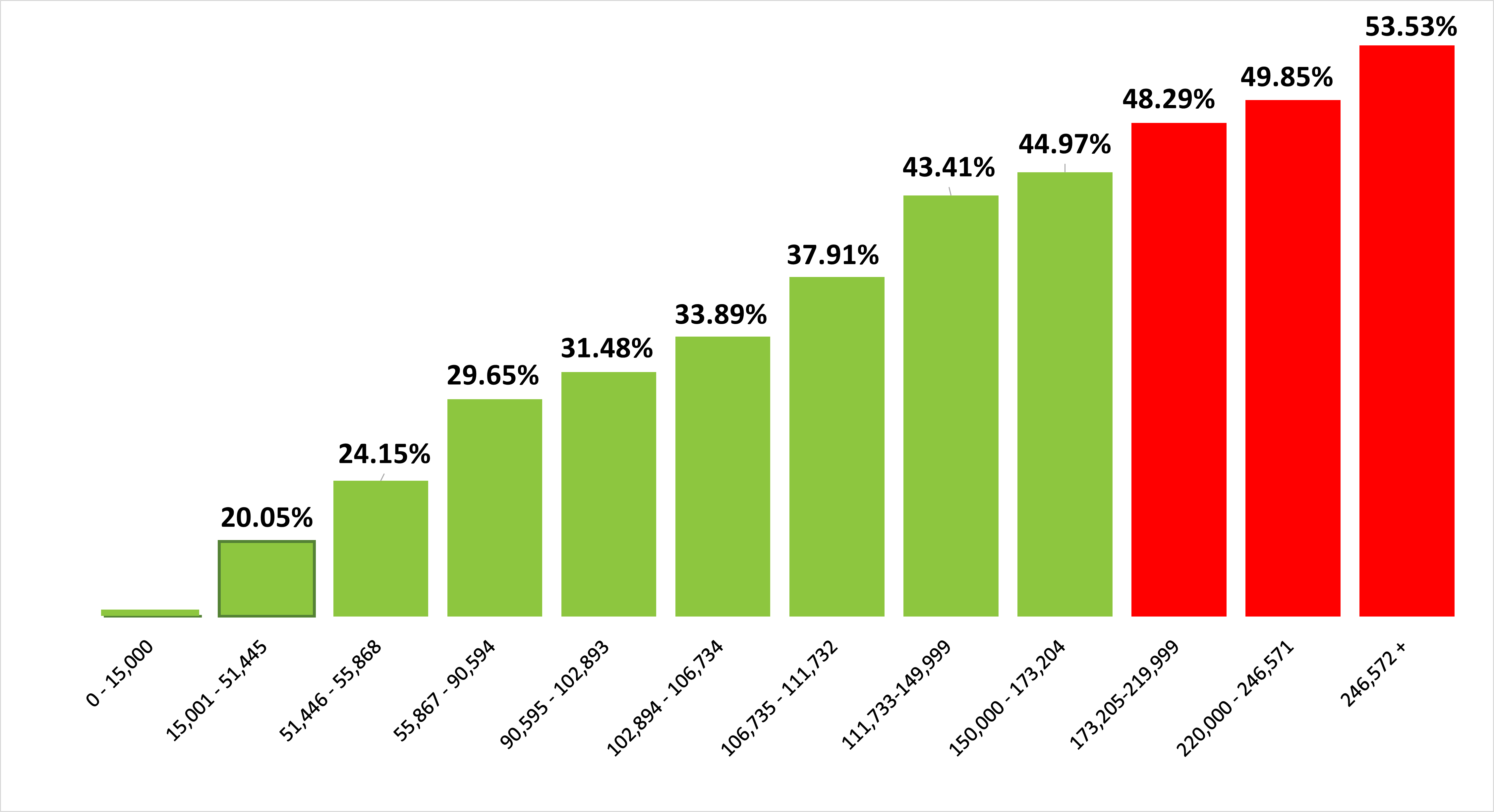
Personal Income Tax Brackets – Ontario 2024
2025-02-06T21:36:57+00:00February 6, 2025|Residents & Fellows, Physicians|

Canada’s income tax system levies federal and provincial taxes on individuals. Canada uses a progressive (graduated) income tax system where your earnings are taxed at higher rates (tax brackets) as your income increases. Tax brackets determine the rate of tax paid for each additional dollar of income within the defined bracket/threshold. Those with lesser incomes pay a lesser percentage of taxes on the income earned in lower tax brackets, while those earning higher incomes in higher tax brackets have to pay a higher rate of tax.

In addition to federal income tax, provincial taxes are imposed by the province or territory in which you reside or carry on business or professional activities. Therefore, a physician working in multiple provinces or territories will be required to allocate their professional earnings between the various provinces or territories. Provincial tax rates, tax brackets, and credits vary by province and are calculated using the taxable income calculated under federal income tax rules on schedules accompanying the T1 Individual tax return.

19 04, 2024

2024 Federal Budget: How the Changes Affect Medical Doctors

2024-04-20T12:42:04+00:00April 19, 2024|Residents & Fellows, Physicians|

On April 17, 2024, the Minister of Finance presented the Budget 2024: Fairness for Every Generation. This blog post briefly summarizes all the tax announcements from the Federal Budget 2024 relevant to physicians.

2024 Federal Budget

Capital Gains Inclusion Rate: Budget 2024 proposes to increase the inclusion rate (the portion of capital gains on which tax is paid) for capital gains realized.  The new rules will apply to capital gains realized on or after June 25, 2024.

  • For individuals with more than $250,000 in capital gains in a year, the capital gain inclusion rate will increase from one-half to two-thirds. Individuals will continue to only pay tax on 50 percent of any capital gains up to $250,000 per year.  Capital gains from principal residences will remain tax-free to ensure Canadians do not pay capital gains taxes when selling their home.  These proposals are expected to have limited impact on physicians unless they realize a significant one-time gain in a year i.e sale of cottage and dispositions on death.
  • For corporations and trusts the inclusion rate will increase to two-thirds for all capital gains (no exemption up to $250,000).  We note that these proposed inclusion rate changes likely disincentivize incorporated physicians, resulting in degrading the integration principles.  Incorporated physicians should consider whether acceleration to trigger capital gains before June 25, 2024, is appropriate.
15 02, 2024

Personal Income Tax Brackets – Ontario 2023

2024-02-16T16:44:11+00:00February 15, 2024|Residents & Fellows, Physicians|

Canada’s income tax system levies federal and provincial taxes on individuals. Canada uses a progressive (graduated) income tax system where your earnings are taxed at higher rates (tax brackets) as your income increases. Tax brackets determine the rate of tax paid for each additional dollar of income within the defined bracket/threshold. Those with lesser incomes pay a lesser percentage of taxes on the income earned in lower tax brackets, while those earning higher incomes in higher tax brackets have to pay a higher rate of tax.

In addition to federal income tax, provincial taxes are imposed by the province or territory in which you reside or carry on business or professional activities. Therefore, a physician working in multiple provinces or territories will be required to allocate their professional earnings between the various provinces or territories. Provincial tax rates, tax brackets, and credits vary by province and are calculated using the taxable income calculated under federal income tax rules on schedules accompanying the T1 Individual tax return.

16 11, 2023

Canada Pension Plan (CPP) Enhancement: How the Changes Affect Medical Doctors

2023-11-17T14:48:10+00:00November 16, 2023|Residents & Fellows, Physicians|

The Canada Pension Plan (CPP) enhancement program (“Enhanced CPP program”) was introduced in 2019 and phased in over a 7-year period (from 2019 to 2025). This blog explains how the new CPP enhancement program will impact CPP contributions rates/calculations, its effect on future CPP retirement pensions, and other tax/financial considerations.

Additional CPP Contribution Requirements

To fund the Enhanced CPP program, the CPP contribution rate has increased gradually every year since 2019 to a total increase of 1% (from 4.95% in 2019 to 5.95% in 2023).  Starting in 2024, a higher, second earnings ceiling (“CPP2 contribution”) will be added and used to determine second additional CPP contributions.

Once a contributor's earnings pass the first earnings ceiling in 2024 any earnings above that but below the second earnings ceiling, will still be considered pensionable earnings but at a different rate. This new rate will be 4% for employees and employers, and 8% for self-employed individuals. In 2024, the second earnings ceiling will be 7% higher than the first earnings ceiling, and then in 2025  and future years it will be 14% higher.

See More...